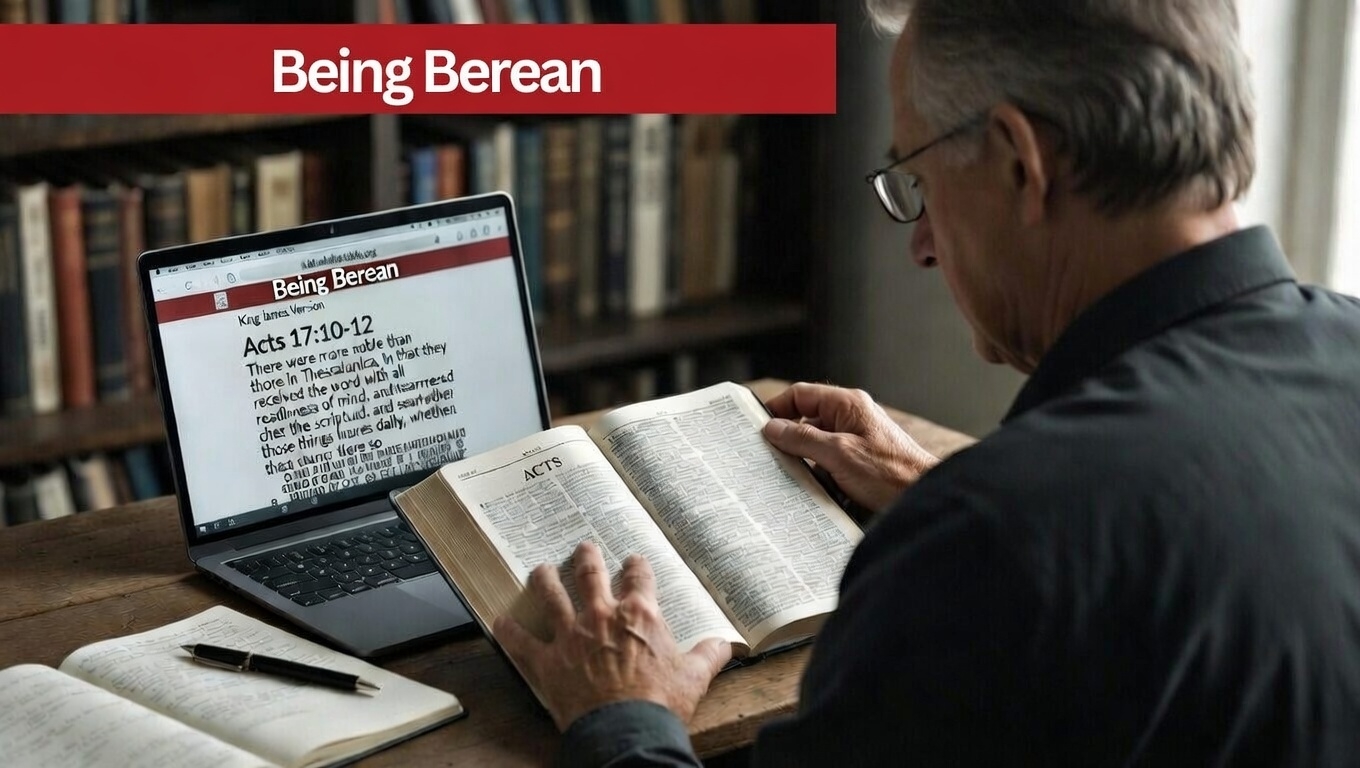

Being Berean using KJB verses NKJV - It is preference mostly.
The key thing to remember is the Footnotes in the NKJV.
And to have KJV close at hand. The continuity of the KJB as to rightly dividing the word is Key to the King James Bible. When NKJB changes thy and ye and Capitalization. It does change the flow of the Word and creates ambiguity in the sovereignty in Gods Word. To be a berean have the King James Bible handy and when You see footnotes READ the KJV and the Holy Spirit will guide you.
As for the many translations out there check which verses are eliminated and which are wholesale changed to meet copyright Laws. Remember Satan is the great deceiver. And his time is short. I expect many more so called translation to come. As to study bibles, there are many and the Holy Spirit needs to be your Guide. But the number one thing they must be based on the KJB or the NKJB. with the caveats mentioned above. May Holy Spirit Guide you as you practice being berean. Study the Scripture.
- Details
- Written by: danwillie
- Category: KJ Bible
- Hits: 31

This is an article Generated by AI
This article is an answer based on the KJB of 1611.
The “Application Importance” of the King James Bible
This is laid out table form -
| Area | Why the KJV is important | How to apply it today
|----------|---------------------------------------|----------------------------------|
- Historical & Textual Authority** | • First major English translation based on the **Textus Receptus** and the best Hebrew manuscripts of its time.<br>• Its
editorial principles (e.g., “the same words that were in the original” and “not to add or take away”) shaped subsequent translations. | • Use it as a reference for
early modern manuscript traditions.<br>• Cross‑check modern translations against the KJV to catch possible editorial shifts. - Theological Clarity** | • Many key doctrines (e.g., the Trinity, salvation, the Lord’s Prayer) are rendered in a way that became the *standard* for
English‑speaking churches.<br>• Its language reinforces *doctrinal teaching*—the *KJV* is the “gold standard” in many confessions (e.g., the Westminster Confession,
the King James Bible, and the 17th‑century Anglican and Presbyterian churches). | • Teach biblical doctrines using the KJV’s wording when possible; it has a “fixed”
theological vocabulary (e.g., *unadulterated* “grace”).<br>• Use the KJV in expository preaching to anchor listeners in the “traditional” wording. - **Liturgical & Hymnody Influence** | • Liturgical books (Book of Common Prayer, various Psalter hymns) use KJV phrasing.<br>• Many hymn writers (e.g., Charles
Wesley) drew directly from the KJV. | • In worship, quote KJV verses to maintain *liturgical continuity*.<br>• In worship music, keep the wording that congregants
already know. - Literary & Rhetorical Power** | • Its *rhythm* (iambic pentameter, anapestic meter) and *imagery* influence English literature for centuries.<br>• Its idioms
(“the lion’s den,” “the book of life”) permeate culture. | • Use the KJV in sermons or teaching to exploit its evocative language.<br>• In literary courses, show how
biblical metaphors enter everyday English. - Cultural & National Identity** | • In the U.S. and U.K. it shaped political discourse (e.g., “the only true God,” “the law of Moses”)<br>• It is the *“King
James”* part of the national consciousness. | • Explain to students how the KJV contributed to the formation of *American* and *British* civic values.<br>• Encourage
cultural literacy by studying the KJV’s impact on poetry, drama, and law. - Pastoral & Spiritual Practice** | • Its phrasing encourages *memorial reading*—repetition of familiar phrasing fosters spiritual discipline (e.g., “the Lord is my
shepherd”).<br>• Many prayer books, meditations, and devotions were originally composed around KJV verses. | • Encourage personal reading by memorizing KJV passages
(e.g., Psalm 23, John 3:16).<br>• Use it for *confession* and *intercession* because the wording feels “commanding.” - Ecumenical & Interdenominational Use** | • Despite doctrinal variations, most denominations use the KJV in a *canonical* sense—“the word of God” remains the same
across denominational lines.<br>• In ecumenical dialogues, KJV provides a *neutral* language that is widely accepted. | • When engaging in interfaith or ecumenical
services, quote KJV verses to avoid denominational bias.<br>• Use KJV to demonstrate shared heritage. - Educational & Research Tool** | • Its footnotes, marginalia, and annotations (e.g., those by William Tyndale’s and later editors) are invaluable for biblical
scholarship.<br>• Many universities keep KJV texts for philological studies. | • Use the KJV as a *primary source* for research on early 17th‑century language,
printing practices, and translation theory.<br>• Teach students to use the KJV in conjunction with original‑language resources.
Why the KJV Still Applies
This table adheres to this layout
| Key Feature | Explanation | Practical Significance |
|--------------------|--------------------|----------------------------------|
- “One of the most accurate English Bibles”** | In the 17th‑century, the KJV was the *first translation* that faithfully reproduced the Greek & Hebrew texts with
minimal editorial interpolation. | Even today, its wording can be a *textual baseline* for Bible study. - “Theological Touchstone”** | The KJV’s language shaped *English‑language theology*: it fixed the phrasing for core doctrines, which in turn were used to write
confessions and catechisms. | Preachers and teachers can rely on this “canonical” wording to avoid confusion. - “Literary Legacy”** | Its poetic cadence and vivid metaphors have become embedded in English literature and everyday speech. | Use the KJV as a *literary
exemplar* in teaching, or employ its phrasing for rhetorical impact. - “Liturgical Continuity”** | Many worship traditions (Anglican, Presbyterian, Methodist, Baptist) have built their liturgies on KJV verses. | Maintain
congregational familiarity by quoting KJV passages during worship. - “Cultural Signifier”** | In the U.S. and U.K., the KJV is a cultural symbol; it appears in political rhetoric, legal references, and popular media. | Use it to
illustrate the historical link between *faith, politics, and culture*.
How to Use the KJV Responsibly
| Step | What to Do | Why It Matters |
|---------|--------------------|-----------------------|
- Read it with Contextual Tools** | Keep a modern commentary or a dictionary of biblical languages on hand. | The KJV’s archaic wording can obscure meaning;
supplements help clarify. | - Pair with Modern Translations** | Use the KJV for the literary & theological “feel” and a contemporary version (e.g., NIV, ESV) for precise wording or difficult
passages. | Readers gain both **beauty** and **clarity**. | - Highlight its Language, Not Just its Words** | Focus on the rhythm, alliteration, and imagery that make the KJV memorable. | This technique makes sermons *sticky*
and helps people remember verses. | - Cite with Footnotes** | When quoting a verse, include a brief note on its textual history (e.g., “originally rendered from the Textus Receptus”). | Educates
listeners that the KJV isn’t the *only* text, but one of many *historical witnesses*. | - Evangelism** | Use the KJV’s clear doctrinal language to explain salvation. | Offer a KJV‑based “core belief” booklet for new believers. |
- Cultural Heritage** | Celebrate the KJV’s role in film, theater, and pop culture. | Include KJV excerpts in “Bible‑in‑culture” courses. |
Practical Scenarios
| Scenario | KJV Usage | Suggested Action |
|---------------|------------------|------------------------------|
Pastoral Preaching** | Use KJV for key doctrinal points (e.g., *John 3:16*, *Ephesians 2:8‑9*). | Quote the KJV verbatim, then paraphrase for clarity if
necessary. |
- |Bible Study Group** | Start the study with a KJV reading and then compare with a contemporary translation. | Highlight differences, ask “Why might the translators
have changed this wording?” | - Worship Planning** | Use KJV verses in hymns, liturgy, and the reading schedule. | Keep the familiar phrasing; add brief explanations for older expressions. |
- Literary Education** | Examine the KJV’s poetic structure and use it as a model for English verse. | Assign projects like “Rewrite Psalm 23 in contemporary
language” to show the impact of wording. | - Civic/Political Education** | Explore how KJV language influenced the Declaration of Independence, the Bill of Rights, and political speeches. | Organize a
lecture series linking KJV verses to foundational documents. | - Evangelism** | Use the KJV’s clear doctrinal language to explain salvation. | Offer a KJV‑based “core belief” booklet for new believers. |
Cultural Heritage** | Celebrate the KJV’s role in film, theater, and pop culture. | Include KJV excerpts in “Bible‑in‑culture” courses. |
4. Bottom Line
The King James Bible is more than an old edition—it is:
1. A foundational witness** to the biblical text that underpins modern translations.
2. A theological standard** that has defined orthodox Christian teaching for centuries.
3. A literary masterpiece** that continues to shape English thought, worship, and culture.
4. A cultural touchstone** that links past generations with present‑day believers and society.
By reading, studying, and preaching from the KJV (while supplementing with modern aids), you honor that heritage, reinforce doctrine, and tap into a powerful
reservoir of language that still speaks to us today
Be Berean
And lastly Be Berean with this AI content. Compare Scripture with Scripture, In the next few years AI will be everywhere and there will be deception of many kinds.
- Details
- Written by: danwillie
- Category: KJ Bible
- Hits: 50